

Plot YAXArrays
This section describes how to visualize YAXArrays. See also the Plotting maps tutorial to plot geospatial data. All plotting capabilities of AbstractDimArray apply to a YAXArrays as well, because every YAXArray is also an AbstractDimArray.
Plot a YAXArrray
Create a simple YAXArray:
using CairoMakie
using YAXArrays
using DimensionalData

data = collect(reshape(1:20, 4, 5))
axlist = (X(1:4), Y(1:5))
a = YAXArray(axlist, data)
┌ 4×5 YAXArray{Int64, 2} ┐
├────────────────────────┴───────────────────────── dims ┐
↓ X Sampled{Int64} 1:4 ForwardOrdered Regular Points,
→ Y Sampled{Int64} 1:5 ForwardOrdered Regular Points
├────────────────────────────────────── loaded in memory ┤
data size: 160.0 bytes
└────────────────────────────────────────────────────────┘Plot the entire array:
plot(a)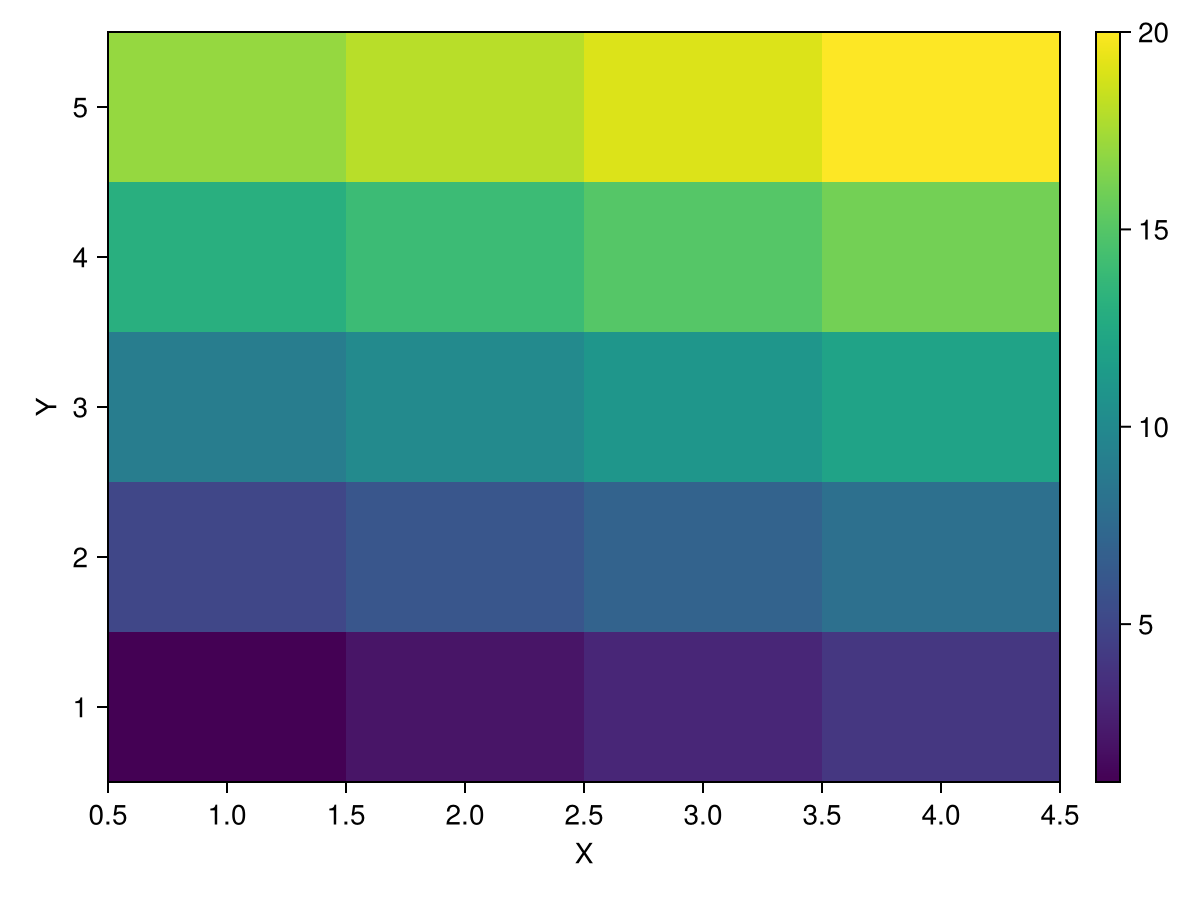
This will plot a heatmap, because the array is a matrix.
Plot the first column:
plot(a[Y=1])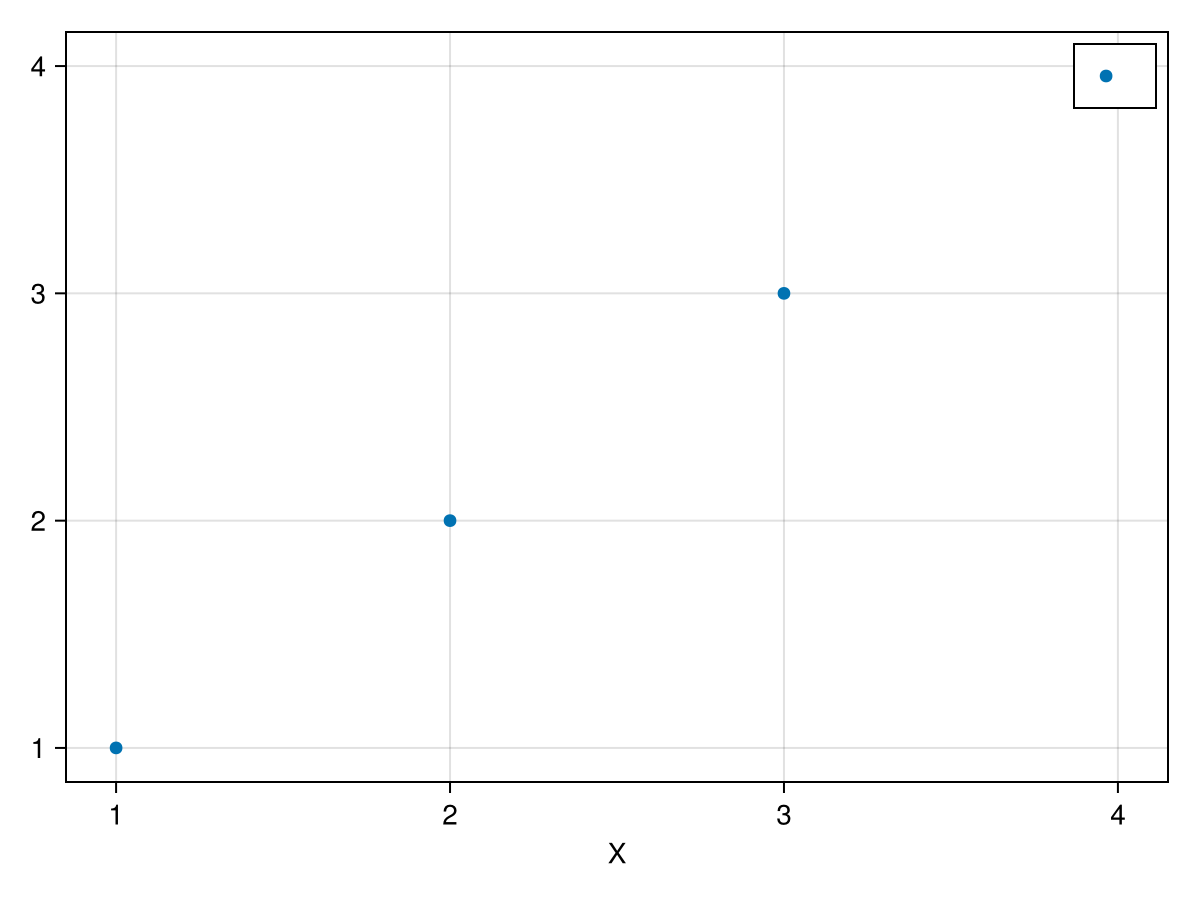
This results in a scatter plot, because the subarray is a vector.
Plot a YAXArrray with CF conventions
Climate and Forecast Metadata Conventions are used to generate appropriate labels for the plot whenever possible. This requires the YAXArray to have metadata properties like standard_name and units.
Get a Dataset with CF meta data:
using NetCDF
using Downloads: download

path = download("https://archive.unidata.ucar.edu/software/netcdf/examples/tos_O1_2001-2002.nc", "example.nc")
ds = open_dataset(path)
YAXArray Dataset
Shared Axes:
(↓ lon Sampled{Float64} 1.0:2.0:359.0 ForwardOrdered Regular Points,
→ lat Sampled{Float64} -79.5:1.0:89.5 ForwardOrdered Regular Points,
↗ time Sampled{CFTime.DateTime360Day{CFTime.Period{Float64, Val{86400}(), Val{0}()}, Val{(2001, 1, 1)}()}} [DateTime360Day(2001-01-16T00:00:00), …, DateTime360Day(2002-12-16T00:00:00)] ForwardOrdered Irregular Points)
Variables:
tos
Properties: Dict{String, Any}("cmor_version" => 0.96f0, "references" => "Dufresne et al, Journal of Climate, 2015, vol XX, p 136", "realization" => 1, "Conventions" => "CF-1.0", "contact" => "Sebastien Denvil, sebastien.denvil@ipsl.jussieu.fr", "history" => "YYYY/MM/JJ: data generated; YYYY/MM/JJ+1 data transformed At 16:37:23 on 01/11/2005, CMOR rewrote data to comply with CF standards and IPCC Fourth Assessment requirements", "table_id" => "Table O1 (13 November 2004)", "source" => "IPSL-CM4_v1 (2003) : atmosphere : LMDZ (IPSL-CM4_IPCC, 96x71x19) ; ocean ORCA2 (ipsl_cm4_v1_8, 2x2L31); sea ice LIM (ipsl_cm4_v", "title" => "IPSL model output prepared for IPCC Fourth Assessment SRES A2 experiment", "experiment_id" => "SRES A2 experiment"…)Plot the first time step of the sea surface temperature with CF metadata:
plot(ds.tos[time=1])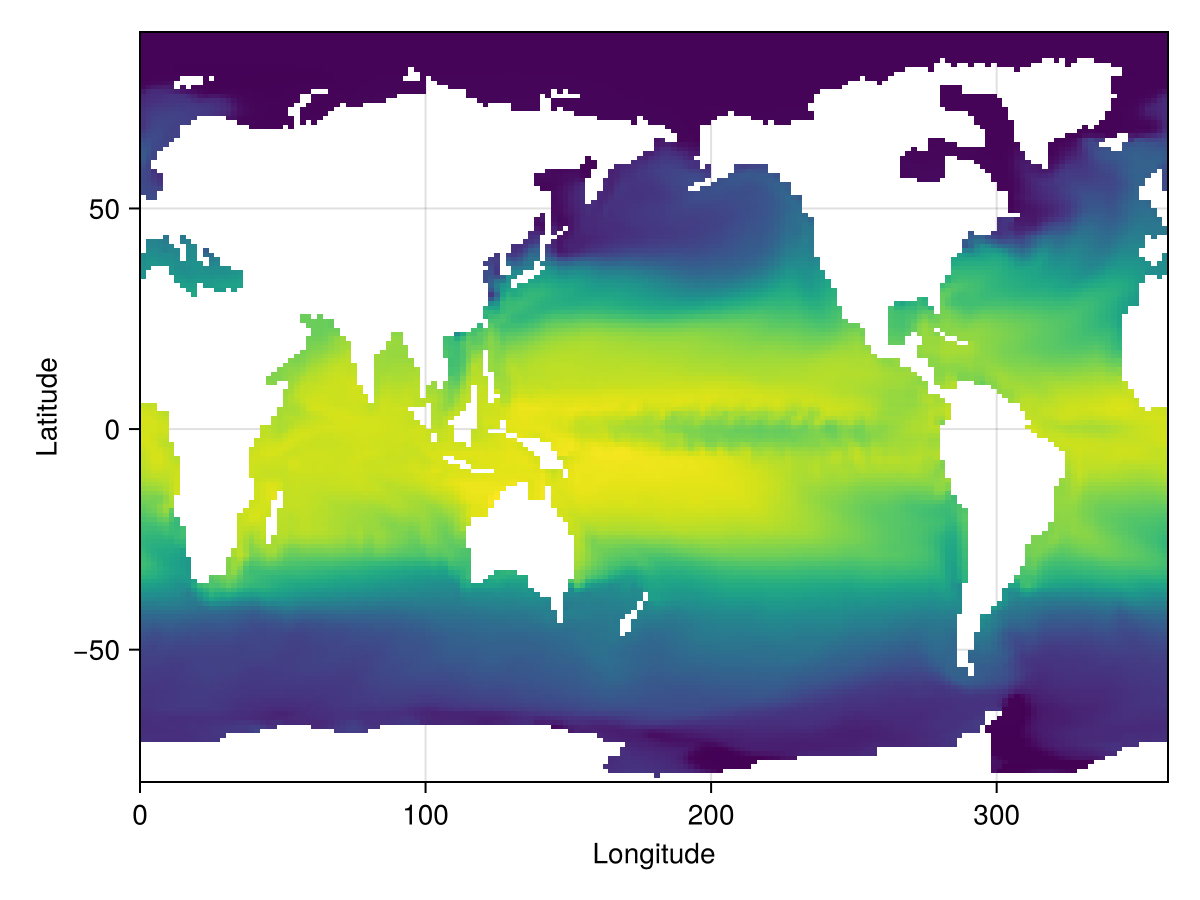
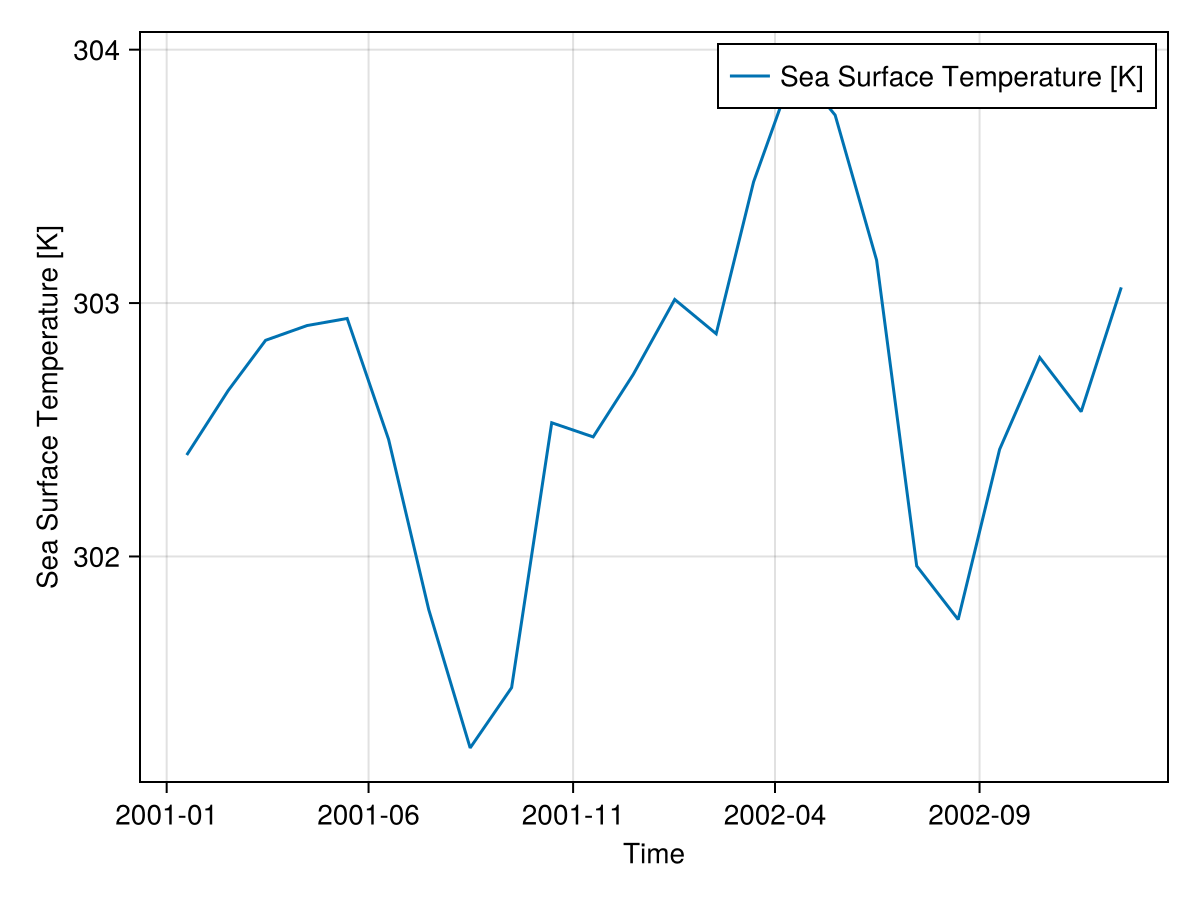
Time in Climate and Forecasting (CF) conventions requires conversion before plotting, e.g., to plot the sea surface temperature over time at a given location (e.g. the null island):
a = ds.tos[lon = Near(0), lat = Near(0)]
times = Ti(map(x -> DateTime(string(x)), a.time.val))
a = YAXArray((times,), collect(a.data), a.properties)
┌ 24-element YAXArray{Union{Missing, Float32}, 1} Sea Surface Temperature ┐
├─────────────────────────────────────────────────────────────────────────┴ dims ┐
↓ Ti Sampled{DateTime} [DateTime("2001-01-16T00:00:00"), …, DateTime("2002-12-16T00:00:00")] ForwardOrdered Irregular Points
├──────────────────────────────────────────────────────────────────── metadata ┤
Dict{String, Any} with 10 entries:
"units" => "K"
"missing_value" => 1.0f20
"history" => " At 16:37:23 on 01/11/2005: CMOR altered the data in t…
"cell_methods" => "time: mean (interval: 30 minutes)"
"name" => "tos"
"long_name" => "Sea Surface Temperature"
"original_units" => "degC"
"standard_name" => "sea_surface_temperature"
"_FillValue" => 1.0f20
"original_name" => "sosstsst"
├──────────────────────────────────────────────────────────── loaded in memory ┤
data size: 96.0 bytes
└──────────────────────────────────────────────────────────────────────────────┘plot(a)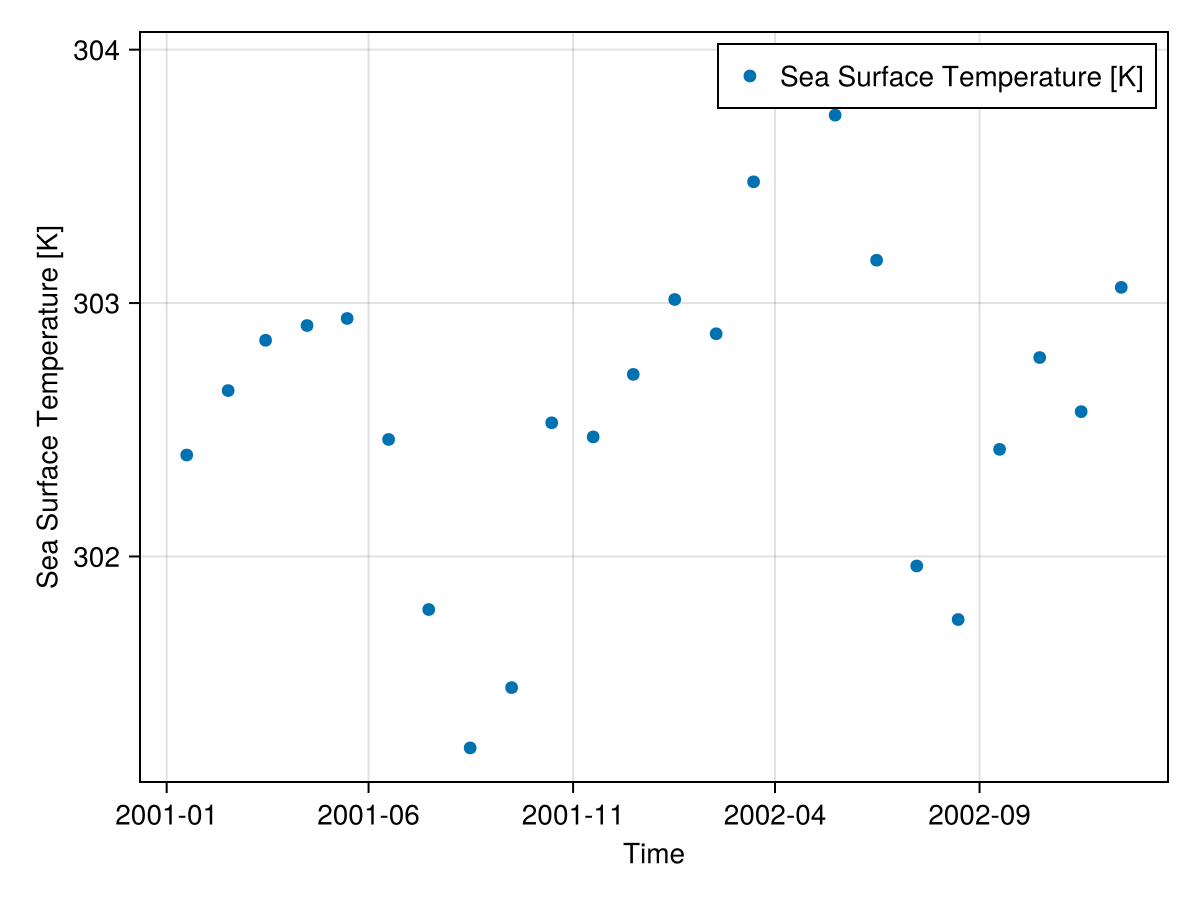
Or as as an explicit line plot:
lines(a)